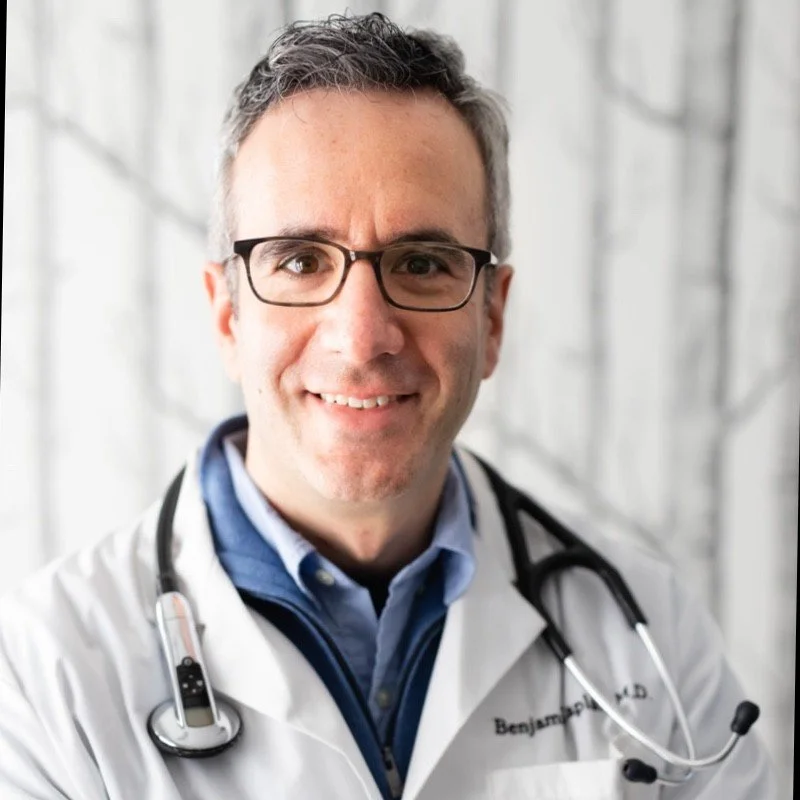
An exclusive conversation with Dr Benjamin Caplan, the physician selected to guide US cannabis policy reform
Read time: 5-6 mins
From Boston to the Eye of the Hurricane
There's something ironic about Dr Benjamin Caplan's journey into cannabis medicine. The son of a world-famous neurologist, trained in some of Boston's best hospitals, he had initially "fully eaten and swallowed all of the baloney" about cannabis being a dangerous drug. What changed his trajectory wasn't advocacy or ideology; it was a skill he had learned early on, simply listening to his patients.
As it happens in medicine, patients come in waves of patterns, shares Dr Ben. Some weeks, every other person has a broken pinky finger, the next week, there is a flush of menopause symptoms or headaches.
"There was one week where everybody came in, and they were suffering with back pain or whatever it was, but they didn't need my prescriptions. They had cannabis."
Dr Caplan recalls that Matrix-like moment when the realities of his patients began to contradict everything he'd been taught and prompted him to do what good doctors do: read voraciously and read sceptically.
What he discovered challenged not just his assumptions about cannabis, but his understanding of how science itself should be interpreted.
"I would read things that were demonising cannabis but then I'd also find in the same searches studies that show the value and the benefits," he explains. "I realised that's healthy science. All of science has a swing from this is good to this is bad."
“Whether it's vitamin D or salt, the history of humankind has always vacillated between science showing something is good and then showing it's bad as others study it and new theories are drawn and falsified. So what I was left with was an impression that there is really good science, despite what everybody says that there's no research, it's just baloney. There's tons of research. It seems like nobody's reading it. Or the media is misreading it, and they're misrepresenting data: trying to sell whatever they're selling, clicks or readership.”
Now, Dr Caplan finds himself in an extraordinary position. As the US tussles with the idea of cannabis rescheduling, he's been selected as the sole physician to help navigate this transition. "It's a lot of pressure, but exciting," he admits.
Rescheduling Cannabis Medicine: A Red Herring?
If you've been following cannabis policy discussions, you've likely heard rescheduling framed as the ultimate goal, the regulatory change that will finally legitimise medical cannabis. Dr Caplan isn't buying it.
"I don't think it's going to come from the rescheduling. When the rubber meets the road, rescheduling essentially means clinicians nationwide are going to have the power to recommend cannabis to their patients. But that army of clinicians doesn't know anything about cannabis. Their patients know more than they do."
This gap in knowledge creates a paradox. No self-respecting clinician will recommend a medicine they don't understand; if it's out of their scope, it's potentially unethical. Dr Caplan draws a parallel to how doctors currently handle exercise and nutrition:
"So many clinicians worldwide kind of haphazardly recommend exercise or say nebulous things like you should ‘eat well’, because they weren't really educated about specific exercises or they don't know the nuances of of nutritional needs for the patient in front of them.
There's a lot of depth to those big things, and cannabis is like nutrition, exercise and sleep is a cross-systemic balancing agent, and doctors aren't going to know how, nor should they be willing to recommend it without proper education.”
The solution? Dr Caplan has spent eight years developing a strategic approach focused on protecting some of the most vulnerable, our seniors. He is trying to make the case that US Medicare should cover all seniors for cannabis medicines by demonstrating that cannabinoid therapy can help reduce hospital congestion, improve quality of life, and generate substantial healthcare savings.
"The ailments of ageing happen to be those conditions which are best helped by cannabinoid-based products. The government is spending billions of dollars on seniors healthcare, on their wellbeing, when there is a whole host of conditions they can manage outside of the clinic and hospital to help people feel comfortable, no matter what they're suffering with. So I try to frame my argument in those terms."
Deconstructing Cannabis Use Disorder
A topic that reveals the intricacies of the cannabis credibility crisis is the discussion around Cannabis Use Disorder (CUD). According to Dr Caplan, the diagnostic criteria are "completely subjective and misinformed."
"If you find benefit from cannabis and take it because you're finding benefit repeatedly, and moreover over time because everybody habituates to anything, you would qualify as having cannabis use disorder. It's sort of a catch-22 that the system got it wrong way back when.
I'm not arguing that cannabis is scot-free, but what constitutes our understanding of what qualifies as problematic consumption is completely wrong."
During our conversation, Dr Caplan distinguishes between Cannabis Use Disorder (CUD) and what he describes as "cannabis overuse", a phenomenon with genuine consequences, but one fundamentally different from the pathological dependence described in the DSM-5 as CUD. In relation to cannabis overuse, Dr Caplan shares his thoughts:
“A substance like cannabis that makes people feel content, that makes them feel satisfied and comfortable, they may not hone other skills because there's nothing motivating them to do that. The issue isn't cannabis toxicity; it's that contentment removes the motivation to develop coping mechanisms. If you don't know how to ask for help, there can be serious consequences."
The global shift toward unbalanced high-THC products creates a perfect scenario for overuse, not because patients are developing pathological dependence, but because high-potency formulations can induce the motivation atrophy he describes.
The complexity continues when accounting for the fact that roughly one-third of medical cannabis users meet DSM-5 criteria for CUD simply through prescribed medical use. Dr Caplan's framework offers a potentially more useful clinical distinction: legitimate medical users developing physiological dependence while maintaining functionality (what is currently labelled as CUD) versus patients experiencing cannabis overuse, characterised by motivational deficits and a loss of interpersonal skills.
The TikTok Problem: When Social Media Replaces Scientific Literacy
One of Dr Caplan's most pressing concerns centres on how medical information now circulates.
"We have a culture now that learns from TikTok and Reels. They're not very sceptical. There aren't too many scientists who are willing and engaging with social media to teach people what is a better read of science."
This isn't just about cannabis, it's about the erosion of scientific literacy at precisely the moment when a critical and nuanced lens matters most.
"The media takes small pieces that sound sexy and just megaphones them, amplifies them beyond their justification"
The consequences extend beyond public confusion. In Australia, as noted in our conversation, an emeritus professor of psychiatry recently claimed "cannabis causes psychosis, there's no evidence base that supports medical use" a statement so divorced from the literature it borders on professional negligence. Such pronouncements from positions of authority don't just misinform; they actively harm patients who might benefit from cannabinoid therapy.
Regarding the often-cited studies showing harm, Dr Caplan's assessment is withering:
"The IQ drop study in the seventies and eighties - the group that had IQ reduction was not even statistically significant. It's just a foul reading of the study.”
Looking Forward: Regulation, Home Cultivation, and Cultural Discipline
As our conversation turned to practical implementation challenges, Dr Caplan raised thoughtful concerns about home cultivation in a newly legal landscape.
"I do believe people should be able to grow whatever plants they want to grow at home," he begins. "But that also means, how can we regulate that as a culture?"
His concern isn't primarily about black markets, it's linked to the unguided consumption of cannabis information:
"In a culture that's really lost its way intellectually with respect to getting information from TikTok and Reels and social media, cannabis seems very enticing and very dangerous. I don't know that human culture has the discipline to be able to self-regulate its consumption in this kind of environment"
This isn't prohibition-era fearmongering; it's a clinician's realistic assessment of what happens when powerful tools become accessible without adequate education. Dr Ben notes the consequences for cannabis are not so obvious compared to alcohol or processed foods, which makes self-regulation more challenging.
His proposed solution? Continue advocating for medical oversight while working to educate both clinicians and patients.
"Our conversation before about cannabis use disorder was assuming supervisory guidance and someone making good, healthy judgments. The challenge is to ensure that guidance is available for the general population."
The Road Ahead: Scientific literacy in medical cannabis discourse
Dr Caplan's work represents something rare in cannabis advocacy, a synthesis of clinical experience, scientific literacy, and strategic thinking grounded in policy reality. Rather than pursuing rescheduling as an end in itself, he's focused on creating the educational infrastructure that will make medical cannabis genuinely therapeutic rather than merely legal.
"There's really good science, despite what everybody says that there's no research, it's just baloney," he insists. "There's tons of research. It seems like nobody's reading it.”
As Australia grapples with its own medical cannabis growing pains, from prescriber education gaps to media-fuelled psychosis panics, Dr Caplan's American experience offers valuable lessons. The path forward requires diligence beyond just regulatory reform. The way forward requires a commitment to scientific literacy, clinical education, and honest engagement with both cannabis's therapeutic potential and its genuine risks.
For healthcare professionals, the message is clear: the endocannabinoid system is not optional knowledge. Understanding it is as fundamental to modern medicine as understanding the cardiovascular or nervous systems. For patients and the public, the challenge is learning to discern between sensational headlines and clinical evidence.
The cannabis credibility crisis won't be solved by legalisation or rescheduling alone. Real change will be achieved much like it always has in the medical cannabis landscape, at the grassroots level, by doctors like Benjamin Caplan and other clinicians willing to read the literature, listen to their patients, and do the hard work of education in an era of TikTok soundbites.
As he puts it: "We're at the cusp of something really amazing." Whether we realise that potential depends on whether we can rebuild the credibility that decades of prohibition destroyed.
Dr Benjamin Caplan's Writings: https://benjamincaplan.com/ & https://doctorapprovedcannabis.substack.com/
Dr Benjamin Caplan is a board-certified family physician and leading advocate for evidence-based cannabis therapeutics, serving as founder and chief medical officer of CED Clinic, The Commonwealth Project, CED Foundation, and EO Care—organisations advancing cannabis medicine, digital health, and senior care reform. His career began with brain imaging research at UCLA, followed by studies at Williams College, medical training at Tufts University School of Medicine, and a family medicine residency at Boston Medical Centre, where he mastered the art of blending science with empathetic care. Having treated tens of thousands of patients and overseen evaluations for over 300,000 medical cannabis cases nationwide, Dr Caplan has built CED Clinic into a research powerhouse with 26,000 active patients and one of the world's largest datasets on cannabis and wellness, while authoring The Doctor-Approved Cannabis Handbook and advising GreenAXS Capital, the top US cannabis investment fund. Recently honoured with presidential recognition for revolutionising senior healthcare through endocannabinoid science, he continues to bridge traditional medicine with plant-based innovations by teaching at Harvard Business School and delivering compassionate, data-driven care to those in need.
Disclaimer: This information is shared with a global readership for educational purposes only and does not constitute medical or business advice. All patient-related information has been de-identified OR fictional to protect privacy. Nothing in this article is intended to promote the use or supply of medical cannabis to members of the public.